Social Networking, Mobile Commerce, and Online Auctions

In this chapter we will learn on how companies can use the Web to improve the things that they have been doing for years; primarily buying and selling. In this chapter, you will learn how companies are using the Web to do things that they have never done before. The Web makes it possible for people to form online communities that are not limited by geography. Individual and companies with common interests can meet online and discuss issues, share information, generate ideas, and develop valuable relationships.

From Virtual community to Social Networking

A virtual community, also called a Web community or an online community, is a gathering place for people and businesses that does not have a physical existence. Howard Rheingold described the characteristics of these communities in his 1993 book.

Bulletin board systems (BBSs) were computers that allowed users to connect through modems (using dial-up connections through telephone lines) to read and post messages in a common area, or electronic bulletin board. BBSs often hosted discussions on specific topics or issues related to specific geographic regions.

Usenet newsgroups were message posting areas on those computers in which interested persons (primarily from the education and research communities) could discuss those topics.

Early Web Communities

As the Web emerged in the mid-1990s, its potential for creating new virtual communities was quickly exploited. In 1995, Beverly Hills Internet opened a virtual community site that featured two Webcams aimed down Hollywood streets; the site also had links to entertainment
information Web sites. The theme of this community was the formation of digital cities around the focus of the Webcams.

Social Networking in the Second Wave of Online Communities

The second wave of electronic commerce saw the introduction of a number of social networking sites. One of the first sites, Six Degrees, started in 1997. Six Degrees was based on the idea that no more than six persons separated anyone in the world from any other person. The site was unable to generate sufficient revenue to continue operations and closed in 2000.
More successful social networking sites followed several years later. Friendster was founded by Jonathan Abrams in 2002. Friendster was the first Web site to includemost of the features found today in all social networking sites. After growing rapidly, its U.S. user base remained steady; however, it continued its rapid growth in Asia and today is one of the leading social networking sites in that part of the world.

M O B I L E C O M M E R C E

Almost all phones sold today include short messaging service (SMS), which allows mobile phone users to send short text messages to each other. Mobile phones such as the BlackBerry have had the ability to send and receive e-mail for years, but until recently, many owners of these phone used them only for phone calls.

Mobile Operating Systems and Applications
In Japan and parts of Southeast Asia, mobile commerce has been a much larger part of online business activity than it has elsewhere in the world (including in the United States) One reason is that these countries introduced high-capacity mobile phone networks long before U.S. network providers did. NTT DoCoMo, which is the largest phone company in Japan, pioneered mobile commerce in 2000 with its i-mode service.
Smart phones come in a range of different styles

O N L I N E A U C T I O N S

One of the Internet’s strengths is that it can bring together people who share narrow interests but are geographically dispersed. Online auctions can capitalize on that ability by either catering to a narrow interest or providing a general auction site that has sections devoted to specific interests. Before you learn more about online auctions, the next section
introduces some basic auction terminology and principles.

Auction Basics

English Auctions-  the English auction, in which bidders publicly announce their successive higher bids until no higher bid is forthcoming. Atthat point, the auctioneer pronounces the item sold to the highest bidder at that bidder’s price.

Yankee auctions- When the bidding concludes in a Yankee auction, the highest bidder is allotted the quantity he or she bid. If items remain after satisfying the highest bidder, those remaining items are allocated to successive lower (next highest) bidders until all items are distributed.

Dutch Auctions- The Dutch auction is a form of open auction in which bidding starts at a high price and drops until a bidder accepts the price.

First-Price Sealed-Bid Auctions-  In sealed-bid auctions, bidders submit their bids independently and are usually prohibited from sharing information with each other. In a first-price sealed-bid auction, the highest bidder wins. If multiple items are auctioned, successive lower (next highest) bidders are awarded the remaining items at the prices they bid.

Second-Price Sealed-Bid Auctions- The second-price sealed-bid auction is the same as the first-price sealed-bid auction except that the highest bidder is awarded the item at the price bid by the second-highest bidder At first glance, one might wonder why a seller would even consider such an auction because it gives the item to the winning bidder at a lower price.

Open-Outcry Double Auctions- The buy and sell offers are shouted by traders standing in a small area on the exchange floor called a trading pit.

Double Auctions- In a double auction, buyers and sellers each submit combined price–quantity bids to an auctioneer. The auctioneer matches the sellers’ offers (starting with the lowest price and then going up) to the buyers’ offers (starting with the highest price and then going down) until all the quantities offered for sale are sold to buyers.

Reverse (Seller-Bid) Auctions- In a reverse auction (also called a seller-bid auction), multiple sellers submit price bids to an auctioneer who represents a single buyer. The bids are for a given amount of a specific item that the buyer wants to purchase.

SUMMARY

In this chapter, you learned how companies are now using the Web to do things that they have never done before, such as creating social networks, using mobile technologies to make sales and increase operational efficiency, operating auction sites, and conducting related businesses.

You learned about the key characteristics of the seven major auction types, and learned how firms are using online auctions to sell goods to their customers and buy from their suppliers. Although some specialty sites do conduct significant auction activities, the consumer online auction business is dominated by eBay, at least in the United States. B2B auctions give companies a new and efficient way to dispose of excess inventory, and B2B reverse auctions provide an effective procurement tool under some conditions. A number of businesses offer ancillary services to Web users who participate in online auctions. These businesses include escrow services, auction directories and information sites, auction management software for both sellers and bidders, and auction consignment sites.

BUSINESS-TO-BUSINESS ACTIVITIES: Improving Efficiency and Reducing Costs

P U R C H A S I N G , L O G I S T I C S , A N D S U P P O R T
A C T I V I T I E S

In this chapter, you will learn how companies use electronic commerce to improve their purchasing and logistics primary activities, and all of their support activities (which include finance and administration, human resources, and technology development). You can refer to Figure 1-9 in Chapter 1 for a review of primary activities and support activities.
Although the work might not be as glamorous as designing a Web site or creating an advertising campaign, the potential for cost reductions and business process improvements in purchasing, logistics and support activities is tremendous.

Purchasing Activities- Purchasing activities include identifying and evaluating vendors, selecting specific products, placing orders, and resolving any issues that arise after receiving the ordered goods or services

Direct vs. Indirect Materials Purchasing – Businesses make a distinction between direct and indirect materials. Direct materials are those materials that become part of the finished product in a manufacturing process. The procurement process for direct materials is an important part of any manufacturing business because the cost of direct materials is usually a very large part of the cost of the finished product. Large manufacturing companies, such as auto manufacturers, engage in two types of direct materials purchasing. In the first type, called replenishment purchasing
(or contract purchasing), the company negotiates long-term contracts for most of the materials that it will need.

Logistics Activities-  The classic objective of logistics is to provide the right goods in the right quantities in the right place at the right time. Logistics management is an important support activity for both the sales and the purchasing activities in a company.

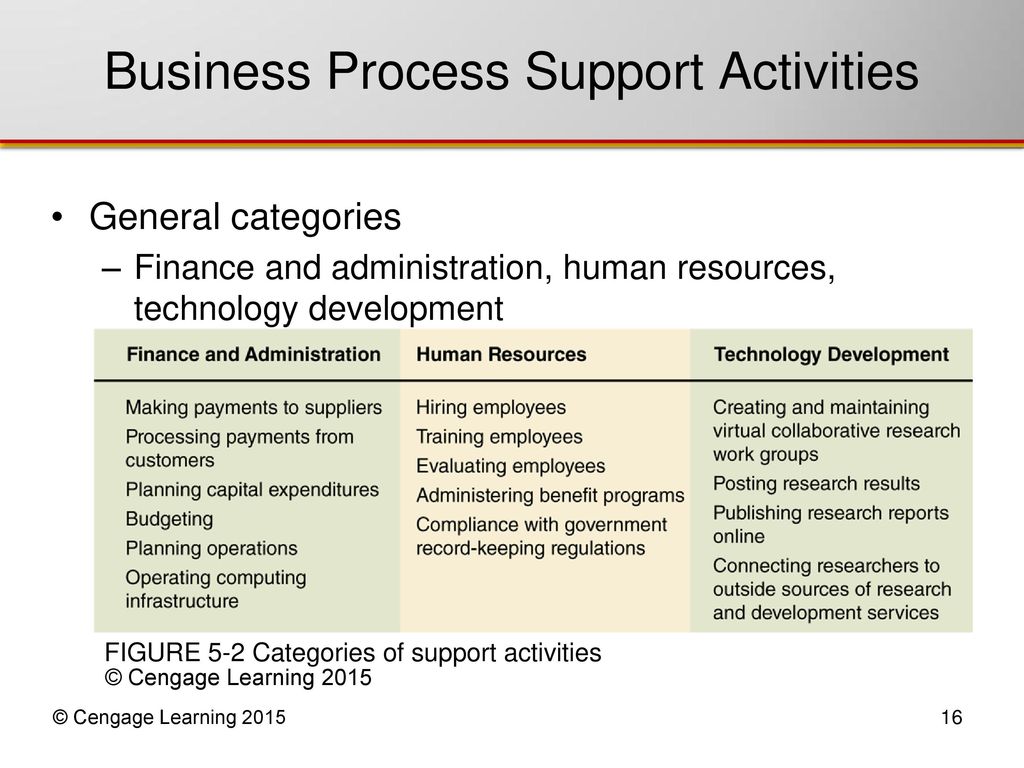
Support Activities – Support activities include the general categories of finance and administration, human resources, and technology development. Finance and administration includes activities such as making payments, processing payments received from customers, planning capital expenditures, and budgeting and planning to ensure that sufficient funds will be available to meet the organization’s obligations as they come due.

General categories. Finance and administration, human resources, technology development. FIGURE 5-2 Categories of support activities. © Cengage Learning © Cengage Learning 2015.

Knowledge management is the intentional collection, classification, and
dissemination of information about a company, its products, and its processes. This type of knowledge is developed over time by individuals working for or with a company and is often difficult to gather and distill.

E-Government   They also collect a variety of taxes and fees from their constituents (you will learn more about how governments use the Web in administering their tax laws. The use of electronic commerce by governments and government agencies to perform these functions is often called e-government.

E L E C T R O N I C D A T A I N T E R C H A N G E

Although the basic idea behind EDI is straightforward, its implementation can be complicated, even in fairly simple business situations. For example, consider a company that needs a replacement for one of its metal-cutting machines. This section describes the steps involved in making this purchase using a paper-based system, and then explains how the process would change using EDI. In both of these examples, assume that the vendor uses
its own vehicles instead of a common carrier to deliver the purchased machine.

SUMMARY

In this chapter, you learned that companies are using Internet and Web technologies in a variety of ways to improve their purchasing and logistics primary activities. Businesses are also making similar improvements in a wide range of support activities such as human resources, accounting,
and technology development. Companies and other large organizations, such as government agencies, are finding it more important than ever to extend the reach of their enterprise planning and control activities beyond their organizations’ legal definitions to include parts of other organizations.
This emerging network model of organization was introduced in Chapter and is usedin this chapter to describe the growth in interorganizational communications and coordination.
EDI, the first example of electronic commerce, was first developed by freight companies to reduce the paperwork burden of processing repetitive transactions. The spread of EDI to virtually all large companies over the past 30 years has led smaller businesses to seek an affordable way to participate in EDI. The Internet is now providing the inexpensive communications channel that EDI lacked for so many years and is allowing smaller companies to participate in Internet EDI.

Marketing on the Web

In this chapter, you will learn how companies are using the Web in their marketing strategies to advertise their products and services and promote their reputations. Increasingly, companies are classifying customers into groups and creating targeted messages for each group. The sizes of these targeted groups can be smaller when companies are using the Web—in some cases, just one customer at a time can be targeted. New research into the behavior of Web site visitors has even suggested ways in which Web sites can respond to visitors who arrive at a site with different needs at different times. This chapter will also introduce you to some of the ways companies are making money by selling advertising on their Web sites.

W E B M A R K E T I N G S T R A T E G I E S

Most companies use the term marketing mix to describe the combination of elements that they use to achieve their goals for selling and promoting their products and services. When a company decides which elements it will use, it calls that particular marketing mix its marketing strategy.

MARKETING STRATEGY on E COMMERCE

Product-Based Marketing Strategies
Managers at many companies think of their businesses in terms of the products and services they sell. This is a logical way to think of a business because companies spend a great deal of effort, time, and money to design and create those products and services.

Customer-Based Marketing Strategies
The Web creates an environment that allows buyers and
sellers to engage in complex communications modes. The communication structures on theWeb can become much more complex than those in traditional mass media outlets suchas broadcast and print advertising.

Market Segmentation on the Web
The Web gives companies an opportunity to present different store environments online. In the physical world, retail stores have limited floor and display space. These limitations often force physical stores to decide on one particular message to convey. Exceptions do exist, such as a music store that has a separate room for classical recordings (with background music that differs from the rest of the store) or a large department store that can use lighting and display space differently in each department; however, smaller retail stores usually choose the one image that appeals to most of their customers.

Advertising on the Web 
Advertising is all about communication. The communication might be between a company and its current customers, potential customers, or even former customers that the company would like to regain. To be effective, firms should send different messages to each of these audiences.

Effectiveness of Online Advertising 
One major problem has been the lack of a single industry standard measuring service, such as the service that the Nielsen ratings provide for television broadcasting or the Audit Bureau of Circulations procedures provide for the print media. In 2004, a joint task force of the Interactive Advertising Bureau (IAB) and the Institute of Practitioners in Advertising (IPA) created a set of media measurement guidelines that all online advertisers can use to produce comparable ad view numbers.

SUMMARY

In this chapter, you learned how companies can use the principles of marketing strategy and thefour Ps of marketing to achieve their goals for selling products and offering services on the Web. Some companies use a product-based marketing strategy and some use a customer-based strategy.The Web enables companies to mix these strategies and give customers a choice about which approach they prefer.

Market segmentation using geographic, demographic, and psycho-graphic information can work as well on the Web as it does in the physical world. The Web gives companies the powerful added ability to segment markets by customer behavior and life-cycle stage, even when the same customer exhibits different behavior during different visits to the company’s site.

Online advertising has become more intrusive since it was introduced in the mid-1990s, even though research has shown that users find such ads to be irritating. You learned how companies are using various types of online ads, including banners, pop-ups, pop-behinds, text, inline text,
and interstitials to promote their sites to potential customers. Permission marketing

Selling on the Web: Revenue Models and Building a Web Presence.

Revenue Models

In business, revenue typically consists of the total amount of money received by the company for goods sold or services provided during a certain time period.1) Therefore, revenue models are a part of the business model.2) Many online companies generate revenues from multiple income streams such as advertising, subscription, affiliate marketing etc. Online models not only sell goods or services but also contacts (e.g. banner) and information (e.g. user-data).

Here are the types of REVENUE MODEL:

Web Catalog Revenue Models-  Buyers place orders by mail or by calling the seller’s toll-free telephone number. This revenue model, which is often called the mail-order or catalog model, has proven to be successful for a wide variety of consumer items, including apparel, computers, electronics, housewares, and gifts.

Digital Content Subscription Revenue Models- Firms that own written information (words or numbers) or rights to that information have embraced the Web as a highly efficient distribution mechanism. Most of these companies use a digital content revenue model; that is, they sell subscriptions for access to the information they own.

Advertising-Supported Revenue Models- The advertising-supported revenue model is the one used by broadcast network television in the United States. Broadcasters provide free programming to an audience along with advertising messages.

Advertising-Subscription Mixed Revenue Models- In an advertising-subscription mixed revenue model, which has been used for many years
by traditional print newspapers and magazines, subscribers pay a fee, but also accept some level of advertising.

Fee-for-Service Revenue Models- These fee-for-service revenue models range from games and entertainment to financial advice and the professional services of accountants, lawyers, and physicians.

SUMMARY

In this chapter, you learned that businesses are using six main approaches to generate revenue on the Web: the Web catalog, digital content sales, advertising-supported, advertising-subscription mixed, fee-for-transaction, and fee-for-service models. You learned how these models work and what kinds of businesses use which models. You also learned that some companies have changed models as they learned more about their customers and the business environment in which their Web sites operate.


Technology Infrastructure

This chapter introduces you to many of the hardware and software technologies that make electronic commerce possible. First, you will learn how the Internet and the World Wide Web work. Then, you will learn about other technologies that support the Internet, the Web, and electronic commerce.
In this chapter, you will be introduced to several complex networking technologies. If you are interested in learning more about how
computer networks operate, you can consult one of the computer networking books cited in the For Further Study and Research section at the end of this chapter, or you can take courses in data communications and networking. Let’s Begin ……….

The Internet and The World Wide Web

A “computer network” is any technology that allows people to connect computers to each other.
An internet (small “i”) is a group of computer networks that have been interconnected. In fact, “internet” is short for “interconnected network.” One particular internet,which uses a specific set of rules and connects networks all over the world to each other, is called the Internet (capital “i”). Networks of computers and the Internet that connects them to each other form the basic technological structure that underlies virtually all electronic commerce.

The part of the Internet known as the World Wide Web, or, more simply, the Web, is a subset of the computers on the Internet that are connected to one another in a specific way that makes them and their contents easily accessible to each other. The most important thing about the Web is that it includes an easy-to-use standard interface. This interface makes it possible for people who are not computer experts to use the Web to access a variety of Internet resources.

The Intranets and Extranets

An intranet is an interconnected network (or internet), usually one that uses the TCP/IP protocol set, and does not extend beyond the organization that created it.

An extranet is an intranet that has been extended to include specific entities outside the boundaries of the organization, such as business partners, customers, or suppliers.

A Virtual private network (VPN) is an extranet that uses public networks and their protocols to send sensitive data to partners, customers, suppliers, and employees using a system called IP tunneling or encapsulation.


PUBLIC AND PRIVATE NETWORKS

A public network is any computer network or telecommunications network that is available to the public. The Internet is one example of a public network.

A private network is a private, leased-line connection between two companies that physically connects their intranets to one another.

INTERNET CONNECTIONS

The Internet is a set of interconnected networks. Most organizations have their computers connected to each other using a network. Here are some familiar connection that we used in our daily live’s to fulfill our wants and needs. or to provide us what we need to shop online.

Voice-Grade Telephone Connections – The most common way for an individual to connect to an ISP is through a modem connected to your local telephone service provider.

Broadband Connections –  Connections that operate at speeds of greater than about 200 Kbps. It is the newest technologies that uses the DSL protocol to provide service in the broadband range is asymmetric digital subscriber line.

Leased-Line Connections – These connections use a variety of technologies and are usually classified by the equivalent number of telephone lines they include.

Wireless Connections – For many people in rural areas, satellite microwave transmissions have made connections to the Internet possible for the first time. The most common wireless connection/WI-FI technology for use on LANs is called Wi-Fi, wireless, Ethernet, or 802.11b.

One version of fixed-point wireless uses a system of repeaters to forward a radio signal from the ISP to customers.

Cellular Telephone Networks The devices that combine the latest technologies available today are called third-generation (3G) mobile phones. Many mobile phones have a small screen and can be used to send and receive short text messages using a protocol called short message service (SMS).

SUMMARY

In this chapter, you learned about the history of the Internet and the Web, including how these technologies emerged from research projects and grew to be the supporting infrastructure for electronic commerce today. You also learned about the protocols, programs, languages, and architectures that support the Internet and the World Wide Web. TCP/IP is the protocol suite used to create and transport information packets across the Internet. IP addresses identify computers on the Internet. Domain names such as http://www.amazon.com also identify computers on the Internet,
but those names are translated into IP addresses by the routing computers on the Internet.

Internet service providers offer many different types of connections to the Internet. Basic telephone connections are the most economical and easiest to install, but they are the slowest. Broadband cable, satellite microwave transmission, and DSL services provide Internet access at relatively high speeds. Other, more expensive options provide the bandwidth that larger businesses need. A variety of wireless connection options are becoming available, including fixedpoint wireless. The wireless connection options available through mobile phones show promise in creating new opportunities for revenue generation, cost reduction, and payment-processing applications.


Electronic Commerce

Before i share my further knowledge to you about the e-commerce works and what really it is in our life. Let’s give you some brief explanation on E-commerce, and the importance pros and cons of it in our daily life.

Introduction to Electronic Commerce

E-commerce or electronic commerce, is the buying and selling of products or services via the Internet. Electronic commerce draws on technologies such as mobile commerceelectronic funds transfersupply chain managementInternet marketingonline transaction processingelectronic data interchange (EDI), inventory management systems, and automated data collection systems.

Electronic Commerce VS Business Commerce

To many people, the term “ELECTRONIC COMMERCE” means shopping on the part of the Internet called the World Wide Web (the Web).Electronic Commerce is the process of selling and buying which done via the web or the internet. Unlike the physical store, in E-Commerce, there is no need for the buyer and the seller to meet with each other in order to do the whole selling and buying process.

Categories of E-Commerce

Some people find it useful to categorize electronic commerce by the types of entities participating in the transactions or business processes. The five general electronic commerce categories are:

1. Business to Business (B2B) Transactions conducted between businesses on the Web.
2. Business to Consumer (B2C) Consumer shopping on the Web.
This is probably the most common form of E-Commerce.
3. Consumer to Consumer (C2C) This kind of E-Commerce includes all electronic transactions of products or services between the customer and another customer.
4. Business Process  Transactions and business processes in which companies, governments, and other organizations use Internet technologies to support selling and purchasing activities.
5. Business to Government (B2G) covers any kind of transactions that carry out between business and government with the internet as their medium. It includes a large variety of services, such as social security, fiscal, legal documents, employments, etc.

In other side some people use the term “ELECTRONIC BUSINESS” (or e-business) when they are talking about electronic commerce in this broader sense. ‘E-Business or Electronic Business refers to the use of internet, extra-net, web, and intranet to conduct businesses. E-Business is quite similar to E-Commerce, but it is more than just a simple act of buying and selling products and services online.

E-Business includes a wider kind of business processes, such as electronic ordering processing, supply chain management, customer relationship management, etc. So basically, E-Commerce is a part of E-Business.

Difference Between E-Commerce and E-Business

there is a big differences between e-commerce and e-business because
Buying and selling things via the internet is known as E-Commerce. On the other hand, E-Business isn’t limited to just buying and selling activities. All the business activities that conducted via the internet will be considered as E-Businesses. For example, the information and computing technologies used to enhance one’s business.

Advantage and Dis-advantage of Electronic Commerce

Advantage

All the advantages of electronic commerce for businesses can be summarized in one statement: electronic commerce can increase sales and decrease costs. Advertising done well on the Web can get even a small firm’s promotional message out to potential customers in every country in the world. A firm can use electronic commerce to reach small groups of customers that are geographically scattered. The Web is particularly useful in creating virtual communities that become ideal target markets for specific types of products or services. A virtual community is a gathering of people who share a common interest, but instead of this gathering occurring in the physical world, it takes place on the Internet. In recent years, virtual communities have taken advantage of Web 2.0 technologies

Disadvantages

Most of the disadvantages of electronic commerce today, however, stem from the newness and rapidly developing pace of the underlying technologies. These disadvantages will disappear as electronic commerce matures and becomes more available to and accepted by the general population. Many products and services require that a critical mass of potential buyers be equipped and willing to buy through the Internet.

In addition to technology and software issues, many businesses face cultural and legal obstacles to conducting electronic commerce. Some consumers are still fearful of sending their credit card numbers over the Internet and having online merchants—merchants they have never met—know so much about them. You will learn more about electronic commerce
security, privacy issues, and payment systems later in this book. Other consumers are simply resistant to change and are uncomfortable viewing merchandise on a computer screen rather than in person. The legal environment in which electronic commerce is conducted is full of unclear and conflicting laws.

SUMMARY

In this chapter, you learned that commerce, the negotiated exchange of goods or services, has been practiced in traditional ways for thousands of years. Electronic commerce is the application of new technologies, particularly Internet and Web technologies, to help individuals, businesses, and other organizations conduct business more effectively. Electronic commerce is being adopted in waves of change. The first wave of electronic commerce ended in 2000. Today, a second wave with new approaches to integrating Internet technologies into business processes is under way.
In this second wave, businesses are focusing less on overall business models and more on improving specific business processes.